CW Pakistan
  • Legacy
    • Legacy Editorial
    • Editor’s Note
  • Academy
  • Wired
  • Cellcos
  • PayTech
  • Business
  • Ignite
  • Digital Pakistan
  • PSEB
    • DFDI
    • Indus AI Week
  • PASHA
  • TechAdvisor
  • GamePro
  • Partnerships
  • PCWorld
  • Macworld
  • Infoworld
  • TechHive
  • TechAdvisor
0
0
0
0
0
Subscribe
CW Pakistan
CW Pakistan CW Pakistan
  • Legacy
    • Legacy Editorial
    • Editor’s Note
  • Academy
  • Wired
  • Cellcos
  • PayTech
  • Business
  • Ignite
  • Digital Pakistan
  • PSEB
    • DFDI
    • Indus AI Week
  • PASHA
  • TechAdvisor
  • GamePro
  • Partnerships
  • Digital Pakistan

Cabinet Finally Greenlights National AI Policy

  • July 30, 2025
Total
0
Shares
0
0
0
Share
Tweet
Share
Share
Share
Share

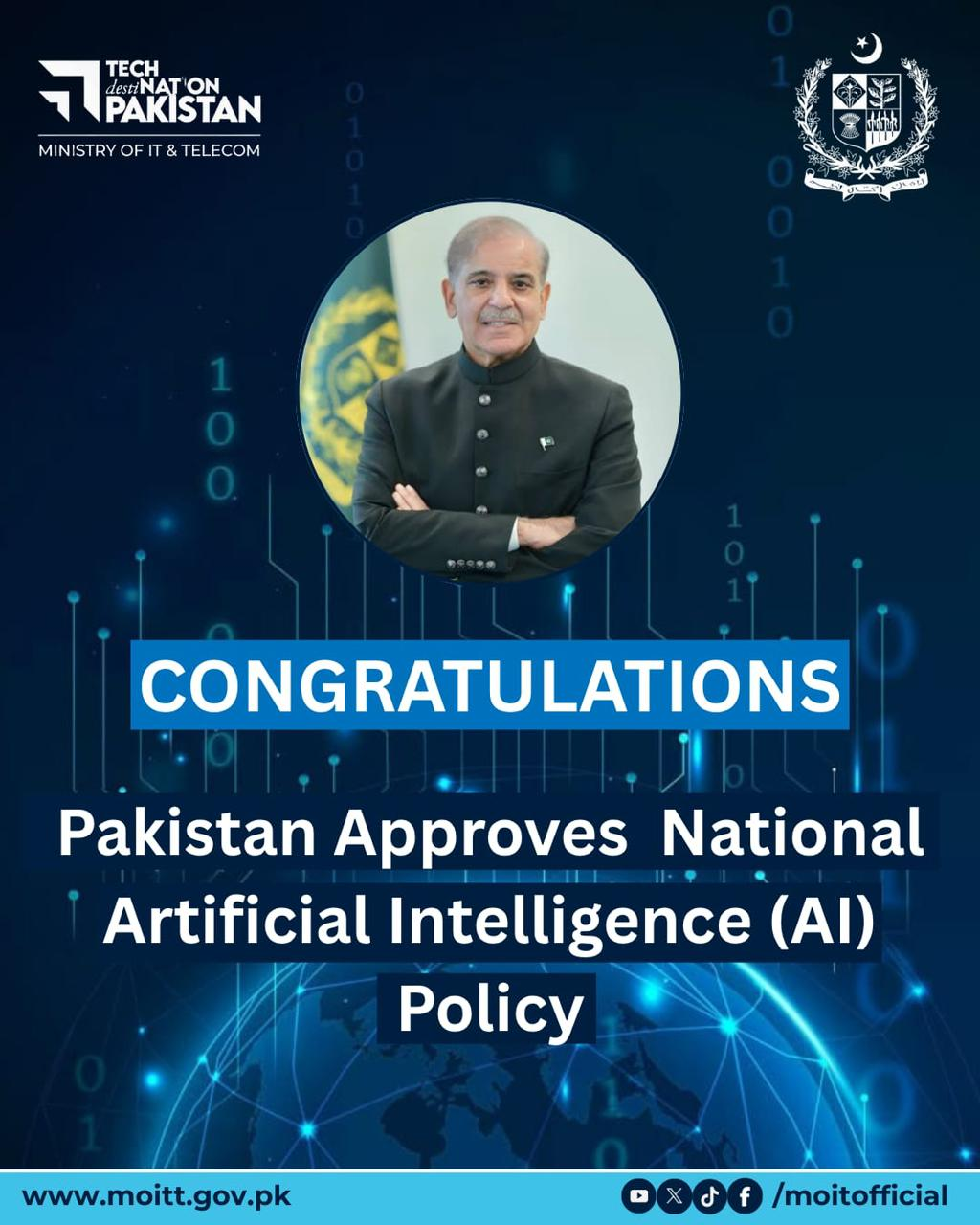
Prime Minister Shehbaz Sharif announced key policy decisions on Wednesday, as the federal cabinet formally approved the National Artificial Intelligence Policy 2025, along with the Hajj Policy 2026, during a meeting held in Islamabad. The AI policy aims to establish a comprehensive AI ecosystem in Pakistan, with a vision to train one million AI professionals by 2030 and launch 1,000 indigenous AI products within the next five years. The initiative represents one of the country’s most ambitious technology-driven reforms to date.

The newly endorsed policy includes launching 50,000 civic projects that will integrate AI solutions for public benefit, offering 3,000 annual scholarships to foster academic growth in the field, and supporting 1,000 research projects to boost innovation and scientific development. Emphasis has been placed on inclusivity, with education and financing provisions for women and differently-abled persons, as well as cybersecurity integration and alignment with international AI regulations.

A dedicated AI Council will oversee policy implementation, supported by a national-level Master Plan and Action Matrix. The government also intends to launch AI Innovation and Venture Funds to promote private sector involvement in AI product development. PM Shehbaz credited the Ministry of IT and associated departments for their work in formulating the policy and underscored that AI adoption will enhance efficiency in sectors like agriculture, public administration, and governance.

Alongside this digital policy initiative, the cabinet approved the Hajj Policy 2026, focused on fully digitising the pilgrimage process. Starting in 2026, 70% of pilgrims will be managed under the government scheme while the remaining 30% will go through private operators. These operators will now face increased accountability. Those who failed to meet obligations in the previous year will be required to facilitate the same pilgrims in 2026, using last year’s costs.

Key improvements include real-time tracking, the use of digital wristbands, mobile applications, SIM card integration, and an updated compensation mechanism. The Ministry of IT will collaborate with the Ministry of Religious Affairs to ensure the digital transformation of all Hajj operations. Speaking to the media, Federal Minister for Religious Affairs Sardar Muhammad Yousaf addressed updates to the policy and noted that the ministry will respond to recent observations made by a Senate Standing Committee sub-committee, which did not consult the ministry during its report preparation.

Yousaf acknowledged that some private Hajj operators failed to deposit payments on time, causing logistical complications. As a remedy, affected pilgrims will now be offered Hajj at last year’s rates. A new financial eligibility criterion has been introduced for private operators to enhance transparency. Monitoring of both public and private schemes will now be handled by a neutral third party. The selection process will follow a first-come, first-served basis, and only pilgrims with Saudi-approved vaccinations will be permitted.

Facilities like the Road to Makkah initiative will operate at Islamabad and Karachi airports. Additional steps include full training for pilgrims, emergency response teams, and a robust financial oversight system. A formal grievance redressal mechanism will be in place, and the Hajj Nazim Scheme will continue. Children under 12 will not be allowed to perform Hajj. Implementation of the 2026 Hajj Policy is scheduled to begin from August 4.

Share
Tweet
Share
Share
Share
Related Topics
  • AI education
  • AI in Pakistan
  • AI startups
  • Civic Tech
  • Digital Pakistan
  • Hajj Policy 2026
  • National AI Strategy
  • Pakistan AI policy
  • Pakistan digital transformation
  • Shehbaz Sharif
Previous Article
  • PayTech

Pakistan to License Banks and Exchanges for Cryptocurrency Operations Under Virtual Assets Act

  • July 30, 2025
Read More
Next Article
  • Ignite

LUMS Blockchain Leadership Summit 2025 to Focus on Digital Assets and Innovation

  • July 30, 2025
Read More
You May Also Like
Read More
  • Digital Pakistan

UET Peshawar And Provincial Services Academy Conclude First Senior Management Course For KP Technical Officers

  • Press Desk
  • April 11, 2026
Read More
  • Digital Pakistan

Punjab Class 8 Results 2026 How To Check Online For All Boards Including Lahore Gujranwala And Faisalabad

  • Press Desk
  • April 11, 2026
Read More
  • Digital Pakistan

Sindh Approves Karachi Safe City Phase Two With 2,314 Smart Cameras And Rs9.98 Billion Budget

  • Press Desk
  • April 11, 2026
Read More
  • Digital Pakistan

Punjab Makes Public Safety App Mandatory For Schools To Strengthen Security And Monitoring

  • Press Desk
  • April 10, 2026
Read More
  • Digital Pakistan

Bank Of Punjab And Office Of AI Sign MoU To Establish AI Data Center And Drive Digital Growth In Punjab

  • Press Desk
  • April 10, 2026
Read More
  • Digital Pakistan

Government’s Pak Identity App For Targeted Petrol Subsidy Crashes On Launch With Server Errors

  • Press Desk
  • April 10, 2026
Read More
  • Digital Pakistan

HEC And Huawei Reaffirm Partnership To Advance AI, Cloud Infrastructure And Digital Education In Pakistan

  • Press Desk
  • April 9, 2026
Read More
  • Digital Pakistan

PM Fuel Subsidy Scheme Available On PakApp For Motorcyclists With Digital Registration

  • Press Desk
  • April 9, 2026
Trending Posts
  • PSEB Launches Fully Funded Digital IC Design And Verification Training Under INSPIRE With PKR 50,000 Stipend
    • April 12, 2026
  • DG Customs Valuation Revises Import Values For Lithium-Ion Batteries Under Valuation Ruling 2062 Of 2026
    • April 11, 2026
  • LUMS Faculty Research On AI-Assisted Medical Diagnosis Published In Nature Health Journal
    • April 11, 2026
  • NED University Journal Of Research Launches Hybrid Open Access Publishing Option For Authors
    • April 11, 2026
  • UET Peshawar And Provincial Services Academy Conclude First Senior Management Course For KP Technical Officers
    • April 11, 2026
about
CWPK Legacy
Launched in 1967 internationally, ComputerWorld is the oldest tech magazine/media property in the world. In Pakistan, ComputerWorld was launched in 1995. Initially providing news to IT executives only, once CIO Pakistan, its sister brand from the same family, was launched and took over the enterprise reporting domain in Pakistan, CWPK has emerged as a holistic technology media platform reporting everything tech in the country. It remains the oldest continuous IT publishing brand in the country and in 2025 is set to turn 30 years old, which will be its biggest benchmark and a legacy it hopes to continue for years to come. CWPK is part of the SPIN/IDG Wakhan media umbrella.
Read more
Explore Computerworld Sites Globally
  • computerworld.es
  • computerworld.com.pt
  • computerworld.com
  • cw.no
  • computerworldmexico.com.mx
  • computerwoche.de
  • computersweden.idg.se
  • computerworld.hu
Content from other IDG brands
  • PCWorld
  • Macworld
  • Infoworld
  • TechHive
  • TechAdvisor
CW Pakistan CW Pakistan
  • CWPK
  • CXO
  • DEMO
  • WALLET

CW Media & all its sub-brands are copyrighted to SPIN-IDG Wakhan Media Inc., the publishing arm of NCC-RP Group. This site is designed by Crunch Collective. ©️1995-2026. Read Privacy Policy.

Input your search keywords and press Enter.