Pakistan filed an estimated 7 AI patents in 2024 while ranking 26th globally for research publications. The country with 42,353 papers a year has built a system that rewards everything except ownership of ideas and it is costing us millions.
In an exclusive piece for CW Pakistan, Muhammad Jawwad Paracha reflects on a contradiction at the heart of Pakistan’s knowledge economy. Last year, while China filed 25,177 AI patents and India crossed 23,000, Pakistan is estimated to have filed fewer than ten. In the same period, Pakistani researchers published over 42,000 scientific papers placing the country among the top 30 publishers in the world. We are loud in the journals and silent in the patent offices. Jawwad, one of Pakistan’s most prolific technology inventors and the first IBM Master Inventor from Pakistan in 72 years, makes the case that this imbalance is not just a statistical curiosity it is the single largest unaddressed weakness in our national innovation story, and it is costing Pakistan billions every year. Article is author’s own personal opinion and not a representation of any organization.
The Numbers Nobody is Talking About
In 2024, the World Intellectual Property Organization (WIPO) released its global AI patent landscape report. China led with 25,177 AI patents. The United States followed with 17,307. South Korea filed 5,635, Japan 4,811, Germany 436, and Australia 298.
Pakistan did not appear on the list. Neither did Bangladesh, Sri Lanka, or most of the developing world.
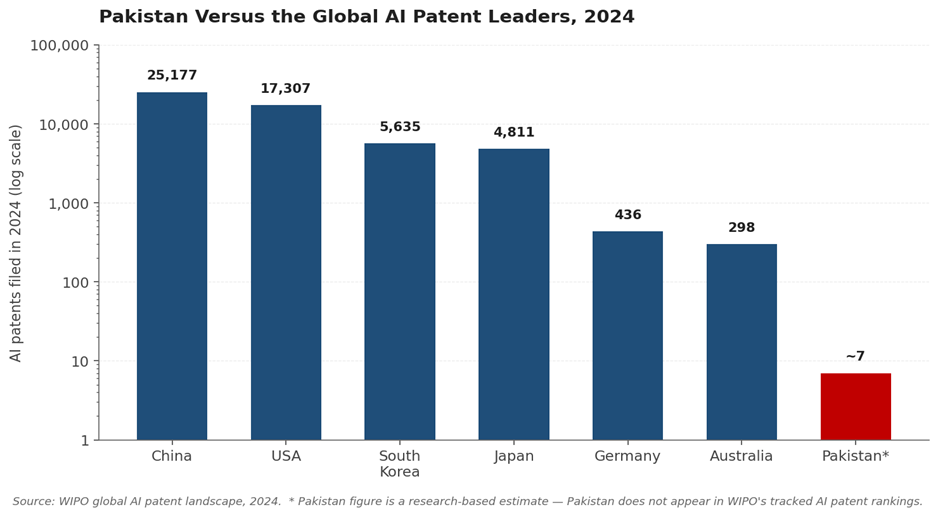
Figure 1: On a logarithmic scale, Pakistan’s estimated ~7 AI patents are barely visible next to China’s 25,177 and the United States’ 17,307. Even Australia, the smallest country tracked by WIPO, files more than 40× what Pakistan does.
A back-of-envelope estimate, based on Pakistan’s total patent output of 528 filings across all technology fields in 2024, places the country’s AI-specific patents in the single digits likely fewer than ten. WIPO does not track us. Stanford’s AI Index does not include us. The Center for Security and Emerging Technology does not cover us. By every meaningful global measure of AI invention, Pakistan is invisible.
And yet and this is the contradiction at the heart of this article in the same year, Pakistani researchers published 42,353 scientific papers, ranking the country 26th globally and 2nd in South Asia. Our output is nearly three times that of Bangladesh, despite comparable economic indicators.
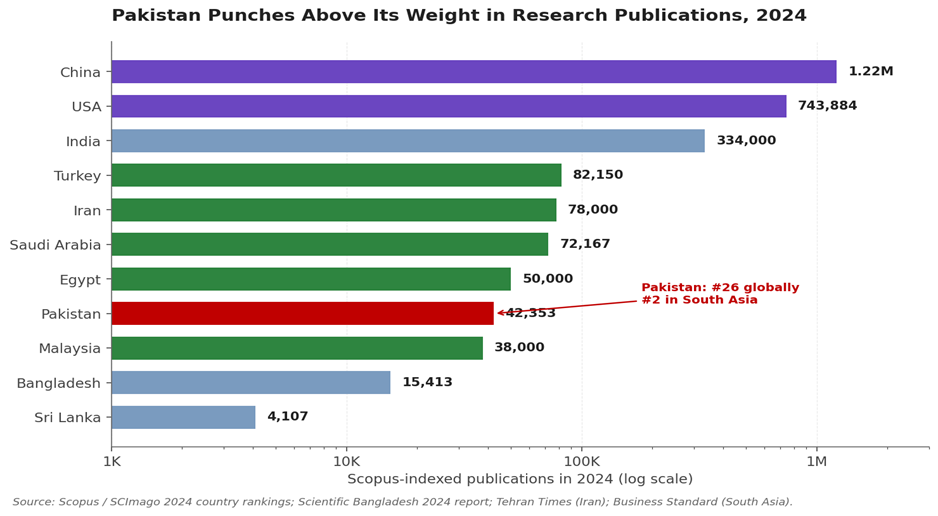
Figure 2: Pakistan ranks 26th globally for Scopus-indexed research publications and second in South Asia behind India. Pakistani academics publish more than the academics of Saudi Arabia, Malaysia, and Bangladesh countries with larger research budgets.
A Publication-Rich, Patent-Poor Nation
The Pakistani research community is not lazy, untalented, or under-skilled. The data shows the opposite. Pakistani academics publish more than the academics of dozens of countries with larger economies and bigger research budgets.
So why is the patent number so low?
Jawwad, who contributed more than 25 patents and publications across AI, networking, and enterprise transformation, calls this the 80-to-1 problem.
“For every patent Pakistan files across all technologies, our researchers publish roughly 80 papers. India is at 6 papers per patent. China is at almost 1 to 1. South Korea actually files more patents than it publishes papers. We are an outlier and not in a good way.”
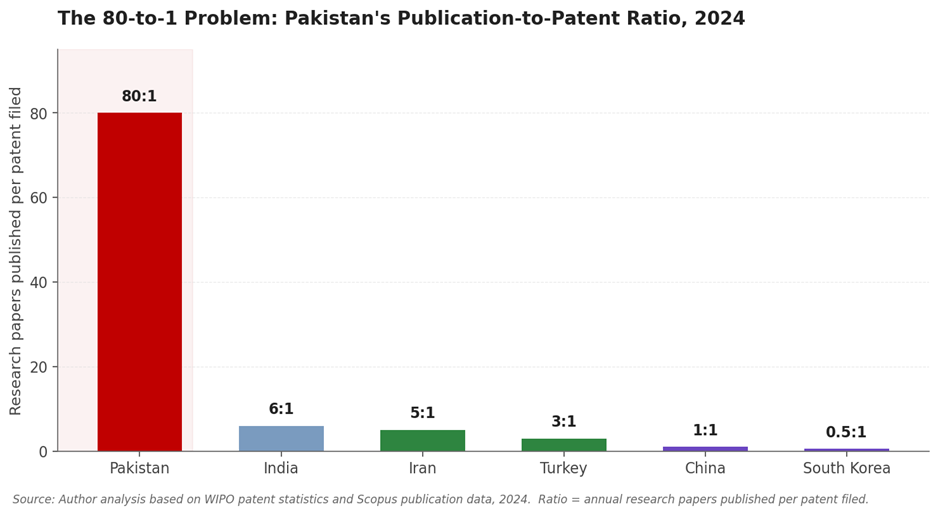
Figure 3: Pakistan publishes roughly 80 research papers for every patent it files. India’s ratio is 6:1, Iran’s is 5:1, Turkey’s is 3:1. South Korea actually files more patents than papers. Pakistan is a global outlier and not in a way the country should want to be.
Jawwad is direct about the structural reasons.
“Our universities reward publications, not patents. A PhD student writing groundbreaking AI work has every incentive to publish in a Scopus-indexed journal as fast as possible and zero incentive to file a patent disclosure first. The HEC promotion criteria, the tenure decisions, the institutional rankings they all weigh papers heavily and patents barely at all. So the brightest minds optimize for what gets them promoted.”
There is also the matter of international access. Pakistan is one of the few significant economies that is not a member of the Patent Cooperation Treaty (PCT) the international system 158 countries use to file patents globally through a single application.
“If you are a Pakistani inventor and you want to file a patent in the US, Europe, Japan, and China, you currently have to file separately in each country, with separate lawyers, separate fees, separate timelines. The cost is prohibitive for most individual inventors and SMEs. Joining the PCT would change that overnight. It is the single highest-leverage policy move available to us, and it doesn’t require a moonshot it requires a signature.”
The economics, he argues, are stacked against the individual inventor.
“Filing a patent in Pakistan costs money. Maintaining it costs more. Enforcing it if someone infringes is a multi-year court battle most people cannot afford. So the rational choice for a researcher becomes: publish for free, get cited, get promoted, move on. We have built a system that punishes patenting and rewards publishing.”
The Regional Picture is Worse Than the Global One
The comparison with China and the United States is dramatic but ultimately distant those are economies twenty times Pakistan’s size. The more uncomfortable comparison is with countries closer to our own scale.
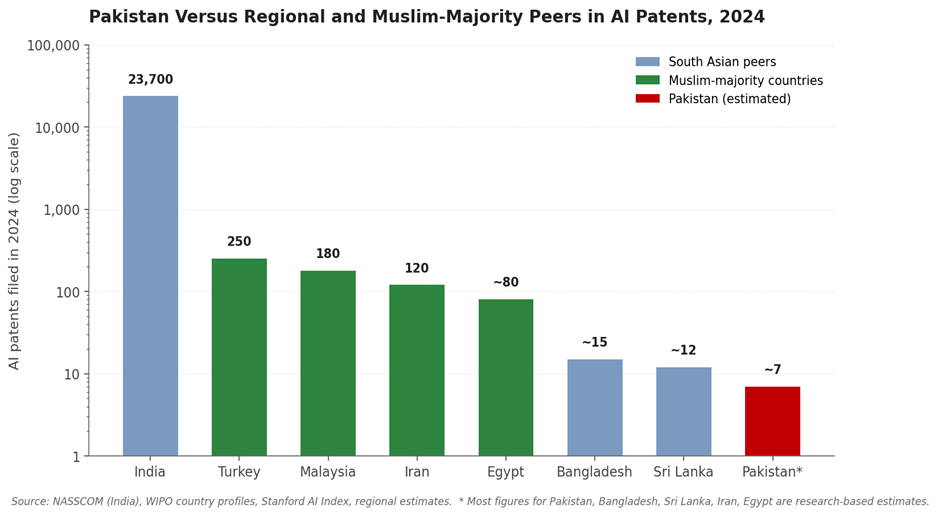
Figure 4: Pakistan trails not only India but also Turkey, Malaysia, Iran, and Egypt all Muslim-majority countries with comparable or smaller GDPs. Even Bangladesh and Sri Lanka are estimated to be ahead of Pakistan in AI patent filings.
“Look at this chart carefully. Pakistan is behind every meaningful peer. Turkey files roughly 35 times what we do. Iran, with significantly fewer engineers than us, files 15 times more. Even Bangladesh and Sri Lanka are ahead on AI patents. These are not countries with magical advantages over us. They are countries that built systems we have not.”
Why Patents Matter More Than Papers Financially
This is where Jawwad’s argument turns from diagnosis to prescription. He wants Pakistanis particularly policymakers, university leaders, and investors to understand a single uncomfortable fact: patents generate national wealth. Papers, mostly, do not.
He cites the numbers without flinching. Qualcomm, the American semiconductor giant, earned roughly $9.4 billion in patent licensing revenue in 2024 alone. One company. One business segment. From patents.
Nokia, Ericsson, and InterDigital three telecom firms whose 5G patents run silently inside every smartphone in Pakistan collectively earned over $4 billion in patent licensing revenue last year.
“A single foundational patent, properly drafted and licensed, can generate more lifetime revenue than thousands of academic papers will ever generate combined. Citations don’t pay for hospitals, dams, or universities. Royalties do. Pakistan’s 42,353 papers in 2024 generated almost no direct licensing revenue for the country. Not because the research is bad much of it is excellent but because we are publishing the recipe and letting the rest of the world open the restaurant.”
The strategic argument, he says, is even larger.
“Patents create leverage. When a country owns standard-essential patents in 5G, AI, batteries, or biotech, every device sold globally that uses those technologies pays a royalty back. That is national income that compounds across decades. Korea understood this in the 1990s. China understood it in the 2000s. India is moving on it now. Pakistan has not even started the conversation seriously.”
The Strategic Cost of Invisibility
Beyond the direct revenue argument, Jawwad makes a sovereignty argument that he believes is underdiscussed in Pakistani policy circles.
“Without a strong patent portfolio, Pakistan becomes a perpetual importer of technology. We pay royalties to use other people’s inventions. We do not collect royalties for ours, because we don’t have any to collect. This shows up in our trade deficit. It shows up in the price of every smartphone, every medicine, every piece of industrial machinery we import. We are paying a hidden tax to the world’s inventor nations, and we are paying it forever.”
What Pakistan Can Actually Do
Jawwad is careful to distinguish between aspirational policy and implementable policy. The list he proposes is deliberately concrete.
Join the PCT immediately. This is the single most consequential reform available, and it is procedural rather than political.
Reform HEC promotion criteria. Weight patents at parity with or above high-impact publications. Make tenure and promotion committees ask: “What did this researcher invent, not just describe?”
“Once the incentives change, behavior changes within a single academic cycle. Engineers and scientists are rational actors. Give them a reason to patent first and publish second, and they will.”
Establish Technology Transfer Offices at every major Pakistani university. Staff them with patent attorneys and licensing specialists. Give them budget to file on behalf of faculty and students. Stanford’s TTO alone has generated over $2 billion for its university.
“There is no structural reason NUST, LUMS, NED, IBA, GIK, or Punjab University cannot run versions of this. The model is well-documented. We don’t need to invent it. We need to install it.”
Launch a national inventor mentorship program. Pair every PhD student in engineering, computer science, and biotechnology with a patent attorney during their final year. Require at least one disclosure attempt as part of graduation.
“The inventor program should be structured. Assign mentors. Get patent attorneys. Provide disclosure templates. Give financial rewards for filings, grants, and trade secret submissions. Right now, Pakistan has nothing at national scale. Inventors here are accidental, not engineered. That has to change.”
Launch a Pakistan AI Patent Mission. A targeted fund of even $5–10 million annually to support Pakistani inventors filing AI, ML, and emerging-tech patents through both domestic and international routes could realistically increase Pakistan’s AI patent output by 100× within five years.
Activate the diaspora. Thousands of Pakistani inventors in the US, UK, Canada, and the Gulf are currently filing patents under foreign company names. A diaspora inventor program offering co-filing in Pakistan, recognition, and joint commercialization pathways could capture significant downstream value without relocating anyone.
Introduce a patent box tax regime. Reduce corporate tax on revenue derived from Pakistan-registered patents. The UK, Netherlands, and Ireland have used this exact mechanism to make patent ownership commercially attractive.
Reform IPO-Pakistan timelines. A patent application that takes five to seven years to grant is a patent that protects almost nothing in fast-moving fields like AI. International best practice is 18 to 36 months. Closing this gap is an operational fix, not a philosophical one.
The Bigger Picture
For Jawwad, the patent gap is not a technical issue. It is a national choice.
“We do not have an idea problem in Pakistan. Walk through any computer science department in Karachi, Lahore, or Islamabad and you will find brilliant work on computer vision, natural language processing, healthcare AI, agritech, fintech. The talent is there. The volume is there. What we have is an ownership problem. We are producing knowledge and giving it away.”
He returns, as he often does in conversation, to the broader shift in the global economy.
“The world has decided that the wealth of nations now lives inside patent portfolios, not inside published papers. The countries that figured this out first South Korea, China, Israel, Singapore are now reaping the dividend in jobs, exports, foreign investment, and global influence. Pakistan can still join this race. The seven AI patents we filed last year is not a ceiling. It is a starting line. But only if we choose, deliberately and at policy level, to stop being a nation that publishes ideas and start being a nation that owns them.”
The contradiction, then, is also the opportunity. 42,353 papers is a number that proves the talent exists. Seven AI patents is a number that proves the system has not yet been built to capture that talent’s commercial value.
Closing that gap, Jawwad argues, is the most important conversation Pakistan’s tech ecosystem is not yet having.
Muhammad Jawwad Paracha is an IBM Master Inventor and AI Leader. He is the first Master Inventor from IBM Pakistan, with 25+ patents and publications across AI, networking, and enterprise transformation. He leads global AI delivery programs scaling Gen AI and Agentic AI across 170+ countries.
Disclaimer: The views and opinions expressed in this article are those of the author and do not necessarily reflect policy or position of any SPIN IDG media platforms. The content is provided for informational purposes only and SPIN is not liable for or does not endorse any products, services, or opinions mentioned in the aforesaid piece.
Follow the SPIN IDG WhatsApp Channel for updates across the Smart Pakistan Insights Network covering all of Pakistan’s technology ecosystem.